
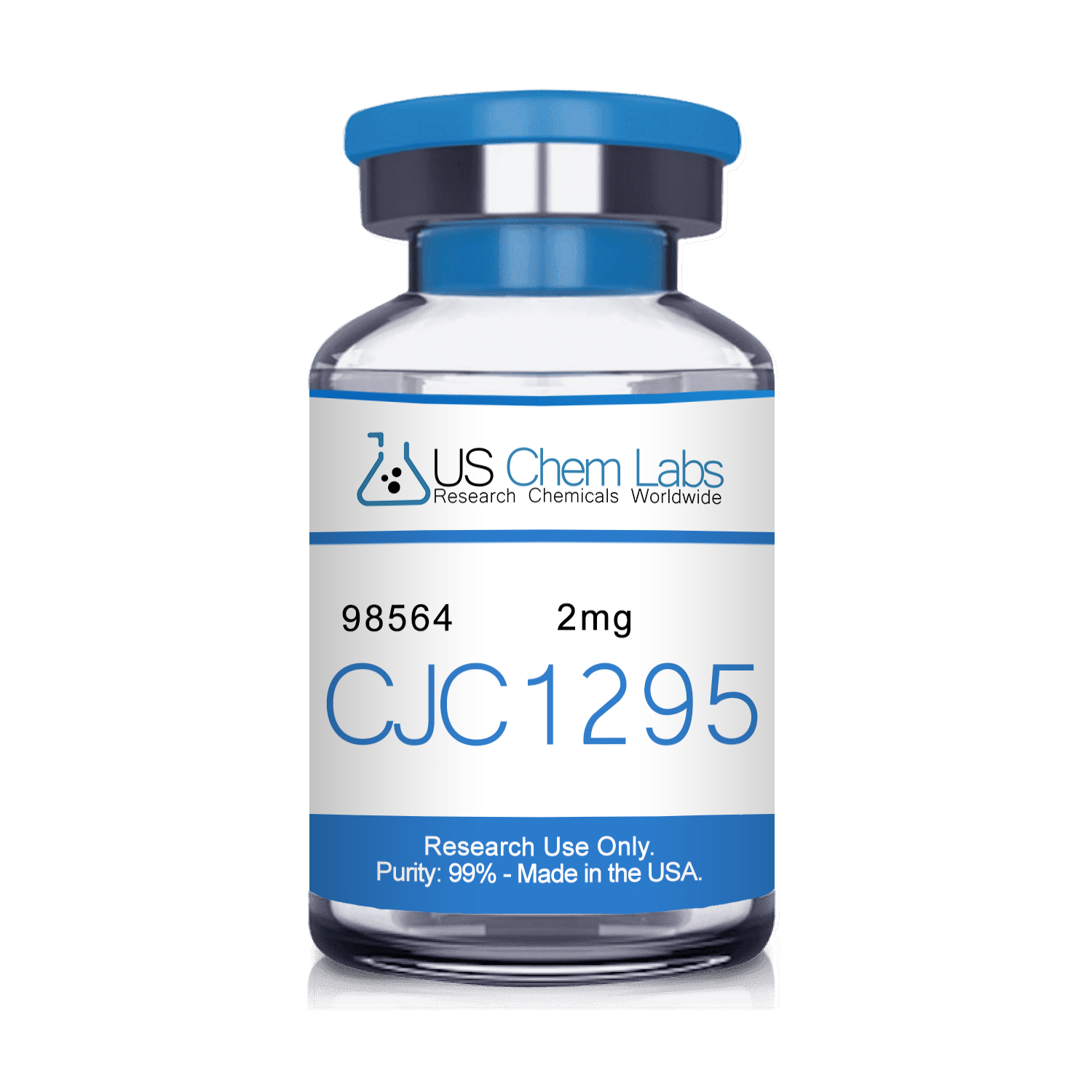
CJC 1295 is a peptide that significantly increases plasma growth hormones and insulin growth factor levels within humans and animals alike. This peptide increases energy levels and induces faster metabolism making it incredibly helpful for those who desire to stay in good shape and exercise on a regular basis.
Maximizes the amount of growth hormone being released into the body to reverse the negative effects of aging to enhance the human body and cause one to feel youthful by naturally:
CJC 1295 addresses growth hormone deficiency, however, those with cancerous tumors should avoid this peptide.
| Sequence | Tyr-D-Ala-Asp-Ala-Ile-Phe-Thr-Gln-Ser-Tyr-Arg-Lys-Val-Leu-Ala-Gln-Leu-Ser-Ala-Arg-Lys-Leu-Leu-Gln-Asp-Ile-Leu-Ser-Arg |
|---|---|
| Appearance | White Lyopholized Powder |
| Specification | 2mg/vial |
| CAS | 446036-97-1 |
| Molecular Formula | C152H252N44O42 |
| Molecular Weight | 3,367.9 g/mol |
Modified GRF (1-29) often abbreviated as mod GRF (1-29), originally known as tetrasubstitued GRF (1-29), is a term used to identify a 29 amino acid peptide analogue of growth-hormone-releasing hormone (GHRH), a releasing hormone of growth hormone (GH). It is a modified version of the shortest fully functional fragment of GHRH, often referred to as growth hormone releasing factor (1-29) (abbreviated as GRF (1-29)), and also known by its standardized name, sermorelin.
Mod GRF (1-29) replacement of the 2nd, 8th, 15th, and 27th amino acids of GRF (1-29) yields modified GRF(1-29) (Tyr-D-Ala-Asp-Ala-Ile-Phe-Thr-Gln-Ser-Tyr-Arg-Lys-Val-Leu-Ala-Gln-Leu-Ser-Ala-Arg-Lys-Leu-Leu-Gln-Asp-Ile-Leu-Ser-Arg-NH2). Half-life at least 30 minutes.
The first 29 amino acids of GHRH were discovered to be as equally potent as its full 44 amino acid structure This fragment became known as GRF (1-29). However, due to a rapid metabolic clearance analogues of GRF (1-29) were synthesized to enhance the biological activity and reduce the rapidity of metabolic clearance. These analogues were primarily created by substituting amino acids within the peptide structure for amino acids more resistant to enzymatic cleavage. One early analogue substituted the amino acid L-alanine (abbreviated as Ala or A) at the 2nd position of the peptide structure for its optical isomer (mirror image), D-alanine (abbreviated as D-Ala). This substitution resulted in a peptide bond between D-Ala and the 3rd amino acid in the structure aspartic acid (Asp) more able to resist rapid cleavage by the enzyme dipeptidyl peptidase-4, a cleavage which had previously led to an inactive peptide fragment. This successful modification prompted the further creation of analogues with additional amino acid substitutions.
DAC stands for drug affinity complex and was developed by ConjuChem Biotechnologies. Why is it an important front runner for use in peptides? Well, typically peptides degrade over time whether that means as a natural peptide created in your body or a synthetic variation. The goal of DAC is to prevent this from happening all while keeping the same biological activity in the peptides. In most cases, there are three parts to the construction of DAC. This includes the peptide itself, a link that is attached to the peptide, and a reactive group at the opposite end of the link. So when DAC is added to CJC 1295 it tends to make it degrade at a much slower pace which allows for cells to reap the many benefits of the peptide.
The biggest difference between CJC-1295 with DAC and CJC-1295 no DAC is that without DAC the peptide has a much shorter half-life of 30 minutes.
Keep peptide vials refrigerated at all times to reduce peptide bond breakdown. DO NOT FREEZE. Most peptides, especially shorter ones, can be preserved for weeks if careful.
Always swab the top of the vial with an alcohol wipe, rubbing alcohol or 95% ethanol before use.
Before drawing solution from any dissolved peptide vial, fill the pin with air to the same measurement you will be filling with solution, ie. if you plan to take 0.1 ml, first fill the pin with 0.1ml of air, push the air into the vial, and then draw the peptide back up to the 0.1 ml marker. Doing so will maintain even pressure in the vial. Always remember to remove air bubbles from the pin by flicking it gently, needle side up, and pushing bubbles out. In addition, push out a tiny amount of solution to ensure there is no air left in the metal tip.
The purity and sterility of bacteriostatic water are essential to prevent contamination and to preserve the shelf-life of dissolved peptides.
Push the pin through the rubber stopper at a slight angle, so that you inject the bacteriostatic water toward the inside wall of the vial, not directly onto the powder.
Lyophilized peptide should be stored at -20°C (freezer), and the reconstituted peptide solution at 4°C (refrigerated). Do not freeze once reconstituted.
Air bubbles are unfavorable to the stability of proteins.